How to Read a Bone Density Scan Report
This post teaches you everything you demand to know about DEXA scans. After reading this, you lot volition be in a better position to ask your md the right questions and brand informed decisions.
I will explain what a DEXA scan is, walk you lot through how to set up for the exam, depict what will likely happen during the examination, identify any risks, and provide insight into how to interpret the results of the DEXA scan.
At the end of this DEXA scan guide, there is a case study of a patient of mine who completed several DEXA scans. Y'all will learn that a careful review of the results is critically important.
In this article I employ the terms DEXA scan and Bone Density Test interchangeably.
This commodity was terminal updated on September x, 2019
Table of Contents
- Definition
- History
- Who Performs and Administers the Exam?
- Understanding the Score
- How Does it Work?
- The Process
- When You Should Have I
- Grooming
- Instance Study
How I Utilise the DEXA Scan
I e'er review the DEXA results with my clients. The data it provides is not simply useful to them, but it gives me considerable insights into the health of their bones. This is peculiarly truthful if the client provides DEXA tests over a menstruation of several years.
Ofttimes, I utilize the information from the DEXA in the FRAX Figurer to gain insight into the patient'south fracture hazard.
The DEXA Scan
When your doctor wants to understand the wellness of your bones, the starting point is the DEXA browse. They volition schedule a DEXA examination at a medical imaging facility and review the results with you.
A Radiologist, a specialist in medical imaging, uses a DEXA scan exam to interpret the wellness of your bones. The DEXA scan report is shared with your physician.
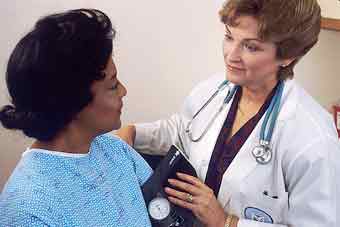
If the results indicate you accept osteoporosis, osteopenia or low os density, your physician uses these results to recommend an appropriate treatment protocol for you.
The recommendations could include a combination of therapeutic exercises, modifications of activities of daily living, changes to your diet and, possibly, pharmaceutical intervention.
Given the important role that a DEXA scan examination plays in the decisions and recommendations that health professionals make, it is critical that the DEXA scan results accurately represent the wellness of your bones.
In the majority of instances, yous should non take to worry. The medical team responsible for your DEXA scan will do an first-class job. However, DEXA scans can get confusing and it helps for you to have a full general thought on what is involved in the process. Let'southward get into that!
What is a DEXA Bone Density Scan?
DEXA is an abbreviation of Dual Free energy X-ray Absorptiometry. DEXA is a medical imaging technology that measures the bone mineral content or density of your bones. Os mineral density is a reliable predictor of fracture risk.
The Cardinal DEXA measures os density of the proximal femur in the hip and pelvis, and lumbar spine in the back. Information technology is the method most preferred by clinicians.
A Peripheral DEXA evaluates the bone mineral density in the forearm, the heel bone (or calcaneus), the wrist and the hand. Some clinicians include this examination during the exam.
In full general, the medical community considers the Central DEXA a more authentic representation of bone mineral density and a ameliorate indicator of fracture take a chance compared to the Peripheral DEXA. While a study in 2017 challenged that position, the current consensus is to rely upon the Fundamental DEXA results. (1)
A Short History of the DEXA
In 1987 DEXA scanners entered routine clinical do. (2) In 1990, a group interested in the utilise and interpretation of bone mineral testing started.
In 1993, a grouping of clinicians formed the Lodge for Clinical Densitometry. They changed their name to the International Society for Clinical Densitometry in 1997 and their mission is "to advance excellence in the cess of skeletal health." This Social club oversees international training and standards for DEXA testing.
In 1997, a grouping of clinicians taught the first bone densitometry form in Toronto, Canada. Certification exams became available across the U.s.a. just over a decade afterwards in 2008.
Who Performs DEXA Testing?
A Os Densitometry Technologist or medical imaging professional person trained by a recognized institution administers the DEXA browse.
To perform a DEXA in most jurisdictions, the clinician has to take either:
- Two twelvemonth undergraduate training in medical imaging sciences.
- 4 year caste in medical imaging sciences.
- The Certified Bone Densitometry Technologist (CBDT®) professional person certification.
Virtually clinicians maintain credentials through ongoing continuing education courses and testing. A number of jurisdictions have standardized accreditation tests for both the technologists and the institutions that offer DEXA scans to the public.
For instance, in Canada, where I live, the Ontario Clan of Radiologists manages the Canadian Bone Mineral Densitometry (CBMD) Facility Accreditation program "to ensure that accredited sites provide the highest standard of BMD services in Canada".
The CBMD "Accreditation signifies to the public that the facility BMD equipment, BMD technologists and the services they provide, and the physicians reporting DXA scan results accept met the rigorous standards set by the CBMD Program."
Accreditation under the program is for a five year period and requires that technologists complete and pass a standardized examination called the Bone Densitometry Precision Calculator.
Where Tin can Yous Get a DEXA Scan?
When you lot accept to take your DEXA, I encourage you to visit medical imaging facilities accredited by a recognized medical body such equally a national Radiologists clan.
The Ontario Association of Radiologists publishes a list of CBMD accredited medical imaging institutions on its website for the public.
The American Higher of Radiologists (ACR) publishes a directory of ACR-accredited facilities qualified to conduct DEXA scans.
Can Untrained Individuals Perform DEXA Scans?
As I mentioned before in my article, your Radiologist and principal intendance physician make important decisions and recommendations based on the results of a DEXA scan. A proper DEXA scan volition generate accurate and meaningful results.
Equally a result, it is important that you consummate your DEXA scan with a qualified and accredited medical imaging institution.
Who Interprets DEXA Tests?
A Radiologist reviews and signs the DEXA report. A Radiologist is a physician who undergoes four years of training on medical imaging afterward medical school.
Radiologists who interpret DEXA results complete specialized training on bone density and DEXA.
The Radiologist volition prepare a report which volition be sent to your principal care md. You lot should allow a space of two weeks before visiting your medico in social club to discuss the DEXA browse os density test results.
Understanding DEXA Scan Results
I have seen instances where a bone density test (DEXA scan) generates what looks similar strange, inconsistent and hard to understand results. Individuals accept loftier bone density examination results scores in one area of their body and depression results in other parts. This is not unusual among people who take been very active in certain sports and activities. Let me explicate in the adjacent sub section.
Bone Edifice is Site Specific.
The upshot of exercise on bone is specific to area stressed during the exercise. If you want stronger leg bones, and then brisk walking, squats and lunges will help. But if you desire stronger arm bones, employ the bones and muscles in your arms by performing arm–specific exercises such equally push-ups or bicep curls.
Studies have shown that bones in the right arm of a correct–handed tennis histrion take a greater density than bones in the left arm of the aforementioned player.
This ways that if you want a stronger body, y'all should have an practice plan that targets every bit many muscles and basic as possible. This is a special feature of the Practice for Amend Bones program. You get a progressive force-training program that covers fourteen dissimilar exercises — that gradually builds over twelve weeks. The exercises specifically target the areas virtually commonly affected by low bone density.
Exercise Recommendations for Osteoporosis
Your physician informs you that your Bone Mineral Density DEXA test results indicate that you have osteoporosis and you demand to showtime a treatment plan.
Yous do your inquiry and acquire that if you take osteoporosis, osteopenia or low bone density that therapeutic practice needs to be part of your osteoporosis treatment program.
Only what exercises should you exercise and which ones should you avoid? What exercises build bone and which ones reduce your chance of a fracture? Is Yoga practiced for your basic? Who should yous trust when information technology comes to exercises for osteoporosis?
A great resource on practise and osteoporosis is my free, seven day email course called Exercise Recommendations for Osteoporosis. Subsequently y'all provide your e-mail address, you will receive seven consecutive online educational videos on bone health — one lesson each day. Y'all can look at the videos at anytime and as oft equally you like. I cover important topics related to osteoporosis exercise including:
- Can exercise reverse osteoporosis?
- Stop the stoop — how to avoid kyphosis and rounded shoulders.
- Key components of an osteoporosis exercise program.
- Key principles of bone building.
- Exercises you should avoid if you take osteoporosis.
- Yoga and osteoporosis — should you lot practise yoga if you lot have osteoporosis?
- Core strength and osteoporosis — why is core strength important if you lot accept osteoporosis?
Enter your email accost and I will start you on this costless course. I practise non SPAM or share your electronic mail address (or any information) with third parties. You can unsubscribe from my mail listing at any time.
How Does a DEXA Scan Work?
During the DEXA browse exam the technician places yous in a supine position on the table part of the DEXA machine. Your knees volition exist flexed and shins elevated. This position decreases the lumbar lordosis and flattens the spine against the table.
The 10-ray tube (the generator) that generates the photons is behind you and the screen that captures the photons (the target) that laissez passer through your torso is located in front the belly. This allows the DEXA motorcar to mensurate the bone mineral density in L1 through L4 in the spine. (3)
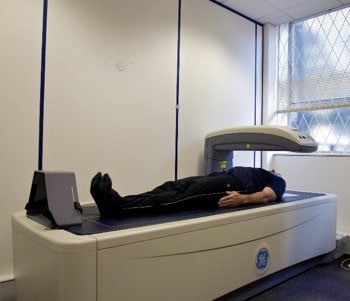 To measure the bone density of the proximal femur (in the hip area), the DEXA technician will have you abduct and internally rotate your leg. If the leg is not adequately abducted and rotated, the bone density measurement of the femoral neck will likely not be accurate. (three)
Like the test for BMD in the spine, the generator in the DEXA scan machine volition generate the photons that volition pass through your hip and pelvis surface area and hit the target. The photon count will bespeak the density of the bone mass in your femoral cervix expanse.
The effect is like to sunlight passing through defunction and hit the floor of a room. The denser the curtain and the closer the lats, the less light that passes through and shows on the floor. In your case, the denser the os, the fewer photons that pass through your trunk and arrive at the target.
[DEXA Car photo attribution: Nick Smith photography [CC Past-SA 3.0 (https://creativecommons.org/licenses/by-sa/3.0)]]
The DEXA Scan Process
The technologist will usually measure ii areas of the body:
- Higher up the pelvis, specifically the lower back (known every bit the lumbar spine).
- Below the pelvis, specifically the thigh bone (known as the proximal role of the femur).
If you have had surgery in either of these two areas in the by, the medical professional person may perform the measurement on i your forearms, too known as a Peripheral DEXA (defined above).
In cases where the patient has had surgery to the back and both of the hips, the medical professional may consider acquiring a bone density test of the whole body, where applicative. This mode is also of selection for the younger population — for example, children and teens.
During the os density test procedure, you will demand to lie on your back on a padded table. Y'all will exist kept in a comfortable position until the DEXA scan is consummate and you lot should remain every bit nevertheless as possible during the measurement. You volition not take to hold your breath.
In most cases the facility volition mensurate the os density of one hip (femoral neck). If your health insurer provides coverage for a measurement of the 2nd hip, the facility will record the second hip as well.
Acme Loss Measurement and Computation
During your visit, the staff will not only measure your bone densitometry, they will carefully measure your height without your shoes on.
Height loss tin can be an important indicator of fractures of the spine. Equally a outcome, summit measurements should exist taken each time yous have a Primal DEXA.
A clinician measures summit loss either with Historical Height Loss (HHL) or Prospective Summit Loss (PHL).
Prospective Height Loss (PHL)
The Prospective Height Loss (PHL) calculates the difference between two measurements of your height taken during a period of up to iii years. In this case, the clinician has ii accurate points to measure height decline.
A PHL score greater than two centimetres suggests a new vertebral pinch fracture. The data is based on studies of women merely can be applied to men.
Historical Height Loss (HHL)
The Historical Height Loss (HHL) is used past a clinician when there is no exact measurement of the client's elevation in past years. In this case, the clinician will use the recalled summit and compare it to the current top.
An HHL greater than six centimetres for an private over 60 and greater than four centimetres for someone under sixty suggests a new vertebral compression fracture. (four)
How Long Does a DEXA Scan Have
The elapsing of the Primal BMD DEXA scan procedure is relatively short, however, y'all should allow 15 to twenty minutes from the time you lot walk into the room until you go out — just to be condom.
What Will a DEXA Scan Tell You lot?
The written report presents your bone mineral density results in three means:
- Bone mass in grams per cm square.
- T-score: a adding made from the DEXA manufacturer comparing your os mass to that of their healthy command group.
- Z-score: a calculation made from the DEXA manufacturer comparing your os mass to that of your peers.
How Accurate is DEXA Browse?
Like virtually measurement technologies, the DEXA is subject area to some degree of error. While they are by and large accurate when it comes to measuring bone density, several factors tin can influence the degree of accurateness. Let's discuss these in detail.
Osteoarthritis
Osteoarthritis can bear on your DEXA browse in several ways. First, if you accept osteoarthritis of the spine, it will crusade the cartilage to deteriorate. This will create pits and spaces around the joint, giving it a rough texture. This crude texture tin affect the photons as they pass through the spine.
2d, if you have arthritis in the hip, information technology can reduce your range of motion and limit your ability to internally rotate your leg. Every bit y'all recall, this internal rotation is required to measure os mineral density in the femoral neck.
Compression Fractures
A pinch fracture in the spine tin can crusade the spinal body to collapse. This will make the bone in the spine appear denser than it really is and atomic number 82 to an inaccurate reading.
Age and Mobility
I mentioned earlier in the post that the technician volition ask you to move into various positions when you are on the examination table. You will also take to flex your knees and flatten your dorsum.
Some people can find these movements a challenge. This is especially the example for older individuals who are less mobile than they were in the past.
Obesity
Obesity can be a claiming for the DEXA equipment. First, the actress size can block the photons equally they pass through the torso and affect the score. Second, some manufacturers limit the size of the people who can take the test. One manufacturer has a weight restriction of 350 pounds.
Thinness
It can be a challenge to get consequent os mineral density scores for people who are thin. A Densitometry Technologist indicated to me that they can become iii different scores when they accept a DEXA scan of a thin person.
A thin person probable has porous bones and this can cause the distribution pattern of the photons to vary each time the browse is executed.
Skills and Qualifications of the Technologist
A technologist who is capable and careful will yield more accurate and undecayed DEXA scan results compared to a poorly trained technician. Brand sure your Technologist is accredited through a recognized trunk.
Quality and Maintenance of the DEXA Machine
DEXA technology is quite complex and the quality of machines can vary. DEXA experts nosotros have spoken with recommend machines from GE Prodigy and Norland.
Another important factor that influences the measurement of the machine is the frequency and maintenance of the equipment. One of the leading medical imaging institutions I spoke to in Ontario indicated that they calibrate and exam their DEXA machines every working twenty-four hours for accuracy.
In improver, they indicated that while their DEXA machines were 10 years old, they replaced the principal components every 3 to five years. These upgrades and replacements accept improved accuracy and reduced radiation levels in their DEXA machines. The components that they change out include the tube, filter, target and the generator.
When Should Yous Have a DEXA Scan?
In many jurisdictions, including the United States and Canada, women over the age of 65 and men over the age of 70 are encouraged to have a DEXA browse for preventative screening purposes.
After the initial DEXA browse, individuals in this group are encouraged to have an examination every twenty four months.
In the United states of america, Medicare will cover the cost of a DEXA browse for women 65 or older and men who are 70 and older.
If you are a adult female nether the age of 65, you should consider a DEXA scan if the following applies to you:
- Family unit history of osteoporosis and, in particular, hip or vertebral compression fractures in your female parent or father.
- Long term utilise of glucocorticosteroids, prednisone or other steroid-type drugs.
- Diagnosed with primary hyperparathyroidism.
- You smoke cigarettes.
- Menopause before the age of twoscore.
- History of a depression bear upon fracture.
- Radiation therapy or chemotherapy for chest cancer.
Baseline DEXA
It is a practiced idea to have a baseline DEXA scan every bit you enter menopause. The results of this exam will requite you an authentic record of the alter of your bone density as yous progress through menopause. It can as well motivate yous to maintain (or fifty-fifty improve) your os density through do and nutrition, thereby reducing the gamble that yous will have have a pharmaceutical like Prolia, Fosamax or Forteo later in life.
Once you have the baseline DEXA, there is no need to have another test for a number of years unless the baseline test identifies that you accept depression os mass.
A baseline DEXA scan is appropriate for nearly men. Osteoporosis is not a woman'southward only status and men should non exist dismissive of information technology. Bone density can decline at a more than rapid charge per unit during andropause when compared to menopause.
Baseline DEXA Score for Richard
Later on reading this post in June of 2019, my husband Richard, asked his doc to prescribe a baseline DEXA to mensurate his bone mineral density. Richard is in his late 50's and younger than the typical age when males get a DEXA browse. Fortunately, Richard has an enlightened physician who supports the DEXA test for men and encouraged him to establish his baseline score.
Several weeks after receiving the prescription, Richard visited an imaging middle in Ottawa and completed the examination. The intake procedure and procedure was similar to that described in this post. When he was setting upwards the engagement, the organizer made information technology clear that he should not take calcium supplements before the test and should article of clothing clothing that did not take metal.
When Richard arrived for the procedure he had to consummate a curt intake form. It asked him if he had a history of fractures, took steroids in the past, and other relevant questions.
The intake class was handed to the Radiology Technologist. When she reviewed his form, she was surprised that he was taking the test at this time. He had no history of fracture and, co-ordinate to guidelines she followed, he was too immature to have the test. When Richard pointed out that he wanted a baseline score and that his mother and sister had osteoporosis, the Technologist was dismissive.
She begrudgingly administered the test and followed the procedures described in this postal service and Richard got what he wanted — a baseline score.
It is expert to monitor your health and a baseline DEXA score is a step in that direction. Unfortunately, you might meet some resistance but I encourage you to press forward and manage your bone health proactively.
Room for Improvement
A report published in March, 2019 in The Spine Journal,Rates of osteoporosis screening and treatment following vertebral fracture, showed that, in some jurisdictions, that not enough people are getting DEXA scans.
Betwixt 2008 and 2014, 2,933 unique patients visited emergency department for ane or more vertebral fractures. The patients were l years and older. Of the patients that visited the emergency department, "ninety-eight pct did not receive a DEXA scan within the preceding 2 years or ane twelvemonth post-obit fracture." (5)
According to one of the co-authors, Jonathan J. Carmouche, M.D., Department Chief of Spine and Pediatrics for the Department of Orthopaedic Surgery at Carilion Clinic in Roanoke, Virginia, "Nosotros establish that we, as the region'south premier 3rd care center, were dropping the ball on over xc% of vertebral fracture patients. They weren't getting DEXA [bone density] scans to formally screen them for osteoporosis or diagnosed clinically and were therefore not being treated or were being nether treated significantly." (6)
Some of these patients probably roughshod through the cracks because they were under the age of 65, some might have been overlooked because their health care plans did not provide adequate screening coverage. However, it seems every bit though we should be more ambitious with this screening in order to go in front of vertebral and hip fractures.
How Much Radiation is in a DEXA Browse?
The DEXA scan examination is very safe. DEXA auto have been reducing the amount of radiation exposure to the point where radiation exposure from a DEXA machine is 1/100 or less compared with a lateral view X-ray of the spine.
Additionally, a Vertebral Fracture Cess (VFA) can exist done at the same fourth dimension and location as measurement of BMD by DEXA.
How Ofttimes Should You Have a DEXA Browse?
How often you get a DEXA scan depends on a number of variables including your age and changes in health. The recommendations tin vary beyond jurisdictions.
As I mentioned earlier, Medicare volition provide a DEXA scan every twenty iv months for women afterwards the historic period of 65.
What are the Limitations of a DEXA?
The DEXA has several limitations:
- A DEXA scan is not able to tell you if you volition have a fracture. It tin simply provide you with a measurement that gets interpreted into your relative risk for a fracture.
- The DEXA cannot tell yous nigh your os quality. If there is a feature to measure TBS, it can provide some insight into your lumbar spine.
- Spinal measurements are express in individuals with spinal deformities such every bit scoliosis, moderate to astringent osteoarthritis, pre-existing compression fractures, or spinal surgeries. (7)
What is TBS (Trabecular Bone Score)?
In the by 2 years I have noticed more information being provided in DEXA reports. One of the more common new features is something referred to every bit TBS. TBS is an abbreviation for Trabecular Bone Score.
Every bit mentioned in past articles, bone density is merely role of the equation that relates to bone strength. The other office is the quality of the bone. When it comes to research studies, bone quality is assessed with tools such as a QCT, Quantitative Computer Tomography. Due to the high levels of radiation exposure, the few number of machines available, and the price of the exam, few individuals outside of inquiry studies will always be referred for a QCT.
The makers of DEXA machines accept attempted to provide physicians with more insight into the quality of the bone through a measurement they call TBS. The TBS score is derived from the grey-level texture measurement of the lumbar spine DEXA.
A loftier TBS score indicates a stronger "internal scaffolding of the vertebra" — more trabecular that are closer together. Whereas a low TBS score indicates the opposite, more trabecular separation, fewer trabecula and therefore a higher risk of vertebral (spinal) pinch fracture.
Although non widely used within existing DEXA machines, studies take shown a correlation between low lumbar spine TBS with the incidence of an old and new fracture. (viii) (9)
DEXA Os Scan Preparation
The following are some of import guidelines for your DEXA bone scan preparation. Read these to prepare for a DEXA scan procedure.
- You should filibuster the DEXA scan if yous are pregnant or if there is a possibility of yous condign pregnant. Should you decide to have the examination anyway, notify the medical professional performing the exam.
- If you are scheduled to take an imaging examination that requires you to receive a dye or other contrast media either by intravenous (IV) injection or orally or rectally, the Central BMD examination should exist performed prior to or at least 7 days later such an imaging examination; e.g.: nuclear scan, CT scan, MRI, Barium studies etc.
On the day of your scheduled Central DEXA BMD (bone density exam) test and every bit part of your bone density test preparation, you should follow these patient preparation guidelines:
- Bring the Primal DEXA BMD (os density test) examination asking your physician has provided along with your health insurance card to the examination facility.
- Testify upwards fifteen to xx minutes prior to your engagement. This will give you aplenty time to register. Exams are normally booked back-to-back. Hence, punctuality is appreciated.
- Swallow a normal diet on the day of the test.
- Take your medications as you usually would.
- Bring an up-to-date list of the medications you are taking.
- Leave any valuables or jewelry y'all usually wear at home.
Os Density Test Grooming Calcium Intake
DO Not take calcium supplements for at least 24 hours before the test.
Can You Eat Before a DEXA Scan?
You tin swallow your regular meals the day of the DEXA scan examination, however, y'all should not take calcium supplements at least 24 hours in accelerate of the scan.
Do You lot Accept to Undress for a Bone Density Test?
In nearly cases yous will not have to undress for a bone density test. The staff and clinician will brand every effort to keep you in your own clothes during the exam. However, the staff may ask y'all to wear a gown.
Depending on the test center, the staff might asking that you remove items that interfere with the DEXA scan including:
- Belts
- Metal buttons
- Keys
- Wallets
- Removable dental appliances
- Eye glasses
What to Wear for Os Density Test
Here are guidelines on what to wear for bone density exam, too as what non to vesture:
- Wear loose plumbing equipment clothes and avert wearing accessories such as belts, clasps, hooks, zippers, thick buttons or glitter ornament.
- Note that bra hooks and metal buttons on dorsum pockets may be unnoticeable to the eye merely volition interfere with the measurement procedure.
- Endeavour not to clothing body-piercing ornamentation to the examination.
Exercise Recommendations for Osteoporosis
Your physician informs you lot that your Bone Mineral Density DEXA examination results point that you have osteoporosis and y'all need to starting time a treatment plan.
Y'all do your enquiry and learn that if you accept osteoporosis, osteopenia or low os density that therapeutic practise needs to exist part of your osteoporosis treatment programme.
Simply what exercises should you exercise and which ones should you avoid? What exercises build bone and which ones reduce your chance of a fracture? Is Yoga good for your basic? Who should you lot trust when it comes to exercises for osteoporosis?
A great resource on exercise and osteoporosis is my gratuitous, seven twenty-four hour period email course called Exercise Recommendations for Osteoporosis. After you provide your email address, y'all will receive seven consecutive online educational videos on os wellness — i lesson each mean solar day. Y'all can look at the videos at anytime and as often as you like.I cover important topics related to osteoporosis exercise including:
- Can exercise reverse osteoporosis?
- End the stoop — how to avoid kyphosis and rounded shoulders.
- Key components of an osteoporosis do program.
- Central principles of os building.
- Exercises you should avoid if you lot have osteoporosis.
- Yoga and osteoporosis — should yous practice yoga if you have osteoporosis?
- Core strength and osteoporosis — why is cadre force important if y'all have osteoporosis?
Enter your email accost and I will start yous on this free class. I exercise not SPAM or share your email address (or whatsoever information) with third parties. You can unsubscribe from my mail list at any time.
What Should You lot Do if Your DEXA Indicates Your Bone Density Declines?
Patients oftentimes visit me considering of a decline in their DEXA score. The reasons for the decline vary from individual to private. The reasons for the modify in scores include their unique genetic makeup, lifestyle, exercise habits, nutrition and medical history.
Response to DEXA Score Pass up
The advisable response to the decline can vary, every bit well. You should always discuss the right strategy with your physician. Your response can include a combination of changes to your:
- Practise plan.
- Activeness level.
- Motion patterns (for example, how you lift things).
- Diet.
- Supplementation.
- Lifestyle activities (for example, if you are a gardener, consider hiring younger people to do the heavy activity around the garden.)
Depending on the degree of modify, pharmaceutical intervention may be required to reduce fracture risk.
Factors to Consider After a DEXA Score Decline
Here are several factors to consider when you see a change in your DEXA scan scores:
- Is the bone density reject significant — to the betoken where your adventure of a fracture is elevated?
- Are y'all able to make the lifestyle modifications required to improve bone density and reduce fracture risk?
- Were there life bug during the by few years which acquired you to spend less time on your own health? Perhaps an aging parent or a sick family unit member took all of your energy and attention.
The correct response to the DEXA score reject for y'all depends on your medical history and the risk of fracture. It is important that you consult with qualified health professionals who can help you make the right decision for yous.
Susan's DEXA Story
Susan (not her existent proper noun) called me afterwards a recent move from Virginia to Utah because she was concerned about the decline in her DEXA browse test results. Her DEXA scans were only taken 14 months apart.
With she moved across the country, she changed health intendance providers and doctors. Her new physician requested a fresh DEXA test.
When I met with Susan she mentioned her surprise in the loss of BMD in simply over a year. Before discussing her exercise regime and how she could better address os loss, I took a look at her BMD DEXA scores.
Unlike manufactures produce very different DEXA machines. Their results should not be be compared. Even machines produced from the same visitor will not be perfectly identical.
When I read that Susan had moved across the state, I requested all of her DEXA results to ensure that the appropriate intensity of practise was prescribed. Both locations used machines from the same manufacturer, which made me more than comfortable to put some weight in comparing results.
My Interpretation of Susan'southward DEXA
Later on looking at the dissimilar DEXA scan results, here is what I establish.
DEXA Hip Scores
Information technology seemed like Susan had hit the perfect storm of DEXA inconsistencies.
Many reports just provide the BMD of one hip. This was the example for her first DEXA scan in Virginia where they just had a reading for her left hip. In Utah, she had a BMD of both hips merely the report only reported on the right. Her correct hip BMD was significantly lower than the left hip BMD. However, when you compared the BMD of her left hip from year to year it was unchanged.
DEXA Spinal Scores
DEXA measurements of the spine are usually taken of the meridian four lumbar vertebra, L1, L2, L3, L4. The scores of all each vertebra was recorded in both locations. In the e coast, they took the average of all four L1 – L4 measurements. In Utah, they only took the average of her top two vertebra, L1 and L2, they had the weakest scores.
By but using the boilerplate of her two weakest scores and non averaging the reading over all iv vertebra, information technology appeared that she had lost significantly more os.
DEXA and the Upper Thoracic Expanse
Some of the newer DEXA centres take apps that let them to get views of the spine from the upper thoracic surface area (simply bellow the shoulders) to the low back. Fortunately, Susan sent me the entire report. Well into the study in that location was a very noticeable Stage 2 compression fracture.
The radiologist had noted it but her doctor had failed to tell her virtually it. When I asked her if she had a past episode of back pain or a fall she did recall a severe episode shortly later on her move. In fact she did not take a fall. During the move she unpacked a lot of boxes and helped her hubby with yard work. The pain lasted 6 to 8 weeks. Considering she had relief with Physical Therapy, she forgot to mention information technology in her intake.
From my indicate of view her vertebral compression was a game changer. We now had information on the quality of her bone.
Lesson Learned from Susan's Story
There are several important lessons you can take from Susan's experience.
1. DEXA Scan Comparison for Femoral Cervix
When comparison DEXA reports be sure you compare apples to apples. Right hip to right or left hip to left.
Several studies accept looked at the differences between BMD of the right and left femoral neck (hip) in postmenopausal women. The 2012 study of 384 postmenopausal Korean women showed a discordance rate of well-nigh thirty%. (10)
A 2017 report with 133 individuals showed an inconsistency in 44% of the cases when they were classified past T or Z-scores, with the everyman scores found in the dominant leg. (11) While discussing similar results with researchers at a os research conference a few years back, we hypothesized that since we lead with the dominant leg the not-dominant leg gets more than of the weight bearing such as when kicking a brawl.
2. DEXA Scan Estimation for the Spine Results
When comparing DEXA's of the spine, they should look akin. Check the size and appearance of the boxes. Also be sure that they are comparing the same parts of the spine L1 to L1, L2 to L2, and so on or equally in Susan's case that they are taking the average of the same vertebra.
3. DEXA Scan and the Thoracic Spine
Another give-and-take of caution in regard to DEXA's and your spine. If the medical imaging institution that you have your DEXA done does not have an app that looks at a bigger picture of your spine then you have to exist your own advocate.
The most common fracture sites in the osteoporotic spine is in the thoracic spine, just effectually your bra strap. For men, this is just below the bottom of your shoulder blades. DEXA reports never capture the thoracic spine for BMD recording because of the interference of our ribs and breast bone.
However, if you have top loss or yous have had sudden onset of back pain that persisted for over iv weeks then the possible source could be a compression fracture of your vertebra.
Contributors
Robert Hakim generously contributed to this article. He wrote the section dedicated to how to gear up for your DEXA exam. Robert M. Hakim G.R.T. (R.), RTR, CDT is a Clinical Densitometry Technologist atDiagnostic Imaging Department – Georgetown Infirmary, Halton Healthcare Services Corporation, Halton Hills, Ontario. Robert is a Member of the International Lodge of Clinical Densitometry.
Master Reference Cloth
- Abdelmohsen, A. Comparing of Primal and Peripheral Os Mineral Density Measurements in Postmenopausal Women. Journal of Chiropractic Medicine, September 2017.
- Blake, GM, Fogelman, I. The role of DXA bone density scans in the diagnosis and treatment of osteoporosis. Postgraduate Medical Journal, Baronial 2007.
- Abdelmohsen, Azza. Comparison of Central and Peripheral Os Mineral Density Measurements in Postmenopausal Women, Periodical of Chiropractic Medicine. September 2017.
- Siminoski K, et al. The accuracy of historical height loss for the detection of vertebral fractures in postmenopausal women. Osteoporosis International. February 17, 2006.
- Barton DW, et al. Rates of osteoporosis screening and treatment post-obit vertebral fracture. The Spine Journal. March 2019. Volume 19, Issue 3, Pages 411–417.
- Over 90% of Fracture Patients do non get a Density Browse! Orthopaedics This week. Feb 28, 2019.
- Garg, MK. Dual energy X-ray absorptiometry: Pitfalls in measurement and interpretation of bone mineral density. Indian Journal of Endocrinological Metabolism. Mar-Apr, 2013. 17(ii): 203–210.
- Harvey, NC, et al. Trabecular bone score (TBS) every bit a new complementary arroyo for osteoporosis evaluation in clinical exercise. A consensus report of a European Society for Clinical and Economic Aspects of Osteoporosis and Osteoarthritis (ESCEO) Working Grouping. Bone. September, 2015. 78: 216-224.
- Silva BC, et al. Trabecular bone score: a noninvasive analytical method based upon the DXA paradigm. Journal of Bone Mineral Research. March 2014. ;29(3):518-30. doi: 10.1002/jbmr.2176.
- Hyun Jung Hwang, et al. Differences in Bone Mineral Density between the Right and Left Hips in Postmenopausal Women. Periodical of Korean Medical Scientific discipline. June 2012. 27(half dozen): 686–690.
- Afzelius P, et al. Dual-energy X-ray Absorptiometry of Both Hips Helps Advisable Diagnosis of Low Bone Mineral Density and Osteoporosis. Diagnostics. 2017 Jul 9;7(iii). pii: E41. doi: 10.3390/diagnostics7030041.
Secondary Reference Textile
- Siminoski K, "Tools and Techniques", Osteoporosis Update, Bound/Summer 2005, Volume 2.
- Winzenrieth R, Michelet F, Hans D. Three-dimensional (3D) microarchitecture correlations with 2nd project image gray-level variations assessed by trabecular bone score using high-resolution computed tomographic acquisitions: effects of resolution and racket. J Clin Densitom. 2013 Jul-Sep; sixteen(3):287-296.
- Black DM, Arden NK, Palermo L, Pearson J, Cummings SR. Prevalent vertebral deformities predict hip fractures and new vertebral deformities but not wrist fractures. Report of Osteoporotic Fractures Research Group. J Os Miner Res. 1999 May; 14(5):821-8.
- Yong Jun Choi. Dual-Energy X-Ray Absorptiometry: Beyond Bone Mineral Density Decision. Endocrinological Metabolism. 2016 Mar; 31(1): 25–30.
- Han J, Hahn MH. Proximal Femoral Geometry as Fracture Risk Gene in Female person Patients with Osteoporotic Hip Fracture. Journal Bone Metabolism. 2016 Aug;23(three):175-82. doi: 10.11005/jbm.2016.23.three.175. Epub 2016 Aug 31.
Osteoporosis Guidelines
For more information, cheque out my Osteoporosis Guidelines.
Source: https://melioguide.com/osteoporosis-prevention/bone-density-test-preparation/
0 Response to "How to Read a Bone Density Scan Report"
Post a Comment