Working I Corporate Is the Only Thing I Can Do as a Liberal Arts Graduate
Why 'worthless' humanities degrees may set yous up for life
A
Every bit we caput into 2020, we're running the best, most insightful and most essential Worklife stories from 2019. Read all of the yr's biggest hits here.
At academy, when I told people I was studying for a history degree, the response was about ever the aforementioned: "Y'all want to be a teacher?". No, a journalist. "Oh. Simply you're not majoring in communications?"
In the days when a academy educational activity was the purview of a privileged few, mayhap in that location wasn't the supposition that a degree had to be a springboard direct into a career. Those days are long gone.
Today, a degree is all but a necessity for the task market, i that more than halves your chances of being unemployed. Yet, that alone is no guarantee of a job – and yet we're paying more and more for one. In the U.s.a., room, board and tuition at a private academy costs an average of $48,510 a year; in the Great britain, tuition fees solitary are £9,250 ($12,000) per year for habitation students; in Singapore, iv years at a private university can cost up to SGD$69,336 (Us$51,000).
Learning for the sake of learning is a beautiful matter. But given those costs, it's no wonder that most of united states of america need our degrees to pay off in a more physical way. Broadly, they already practice: in the Us, for example, a bachelor's caste holder earns $461 more each week than someone who never attended a university.
You might also like:
• The faster fashion to larn a new linguistic communication
• How to teach a distracted generation
• The examination that brings a whole country to a standstill
Merely most of us want to maximise that investment – and that tin can atomic number 82 to a plug-and-play type of approach to higher education. Want to be a journalist? Report journalism, we're told. A lawyer? Pursue pre-law. Non totally certain? Go into Stem (science, technology, engineering and maths) – that way, you can become an engineer or IT specialist. And no thing what yous do, forget the liberal arts – not-vocational degrees that include natural and social sciences, mathematics and the humanities, such as history, philosophy and languages.

The benefit of a humanities degree is the emphasis it puts on pedagogy students to think, critique and persuade (Credit: BBC/Getty)
This has been echoed by statements and policies around the world. In the US, politicians from Senator Marco Rubio to quondam President Barack Obama take fabricated the humanities a punch line. (Obama afterwards apologised). In China, the government has unveiled plans to turn 42 universities into "earth class" institutions of science and technology. In the Great britain, government focus on Stem has led to a most 20% drop in students taking A-levels in English language and a 15% reject in the arts.
But in that location'south a problem with this approach. And information technology's not merely that nosotros're losing out on crucial ways to understand and improve both the globe and ourselves – including enhancing personal wellbeing, sparking innovation and helping create tolerance, among other values.
It'south besides that our assumptions about the market value of certain degrees – and the "worthlessness" of others – might exist off. At best, that could be making some students unnecessarily stressed. At worst? Pushing people onto paths that set them up for less fulfilling lives. It likewise perpetuates the stereotype of liberal arts graduates, in particular, equally an aristocracy caste – something that can discourage underprivileged students, and anyone else who needs an immediate render on their university investment, from pursuing potentially rewarding disciplines. (Though, of form, this is hardly the but diversity trouble such disciplines accept).
Soft skills, critical thinking
George Anders is convinced we have the humanities in particular all wrong. When he was a technology reporter for Forbes from 2012 to 2016, he says Silicon Valley "was consumed with this thought that in that location was no education simply Stem didactics".
But when he talked to hiring managers at the biggest tech companies, he establish a different reality. "Uber was picking up psychology majors to bargain with unhappy riders and drivers. Opentable was hiring English majors to bring data to restauranteurs to get them excited virtually what data could do for their restaurants," he says.
"I realised that the ability to communicate and get forth with people, and understand what's on other people's minds, and exercise full-forcefulness critical thinking – all of these things were valued and appreciated by everyone every bit important job skills, except the media." This realisation led him to write his accordingly-titled book You Can Do Anything: The Surprising Power of a "Useless" Liberal Arts Education.

For many students future earnings have become a 'litmus examination' for deciding betwixt dissimilar universities and subjects to specialise in (Credit: Jopwell Collection)
Take a wait at the skills employers say they're after. LinkedIn's research on the most sought-after task skills by employers for 2019 found that the three most-wanted "soft skills" were creativity, persuasion and collaboration, while i of the five top "hard skills" was people direction. A full 56% of UK employers surveyed said their staff lacked essential teamwork skills and 46% thought information technology was a problem that their employees struggled with handling feelings, whether theirs or others'. It'southward not just UK employers: 1 2017 study found that the fastest-growing jobs in the US in the last xxx years have most all specifically required a high level of social skills.
Or take information technology straight from two top executives at tech behemothic Microsoft who wrote recently: "Every bit computers behave more like humans, the social sciences and humanities will become even more important. Languages, art, history, economics, ethics, philosophy, psychology and human development courses tin teach critical, philosophical and ideals-based skills that will be instrumental in the development and management of AI solutions.
Of grade, it goes without saying that you tin be an splendid communicator and critical thinker without a liberal arts degree. And any good university didactics, non just 1 in English or psychology, should acuminate these abilities farther. "Any degree will give you very important generic skills like being able to write, being able to present an argument, research, problem-solve, teamwork, becoming familiar with technology," says Dublin-based educational consultant and career coach Anne Mangan.
Simply few courses of study are quite as heavy on reading, writing, speaking and critical thinking as the liberal arts, in particular the humanities – whether that's by debating other students in a seminar, writing a thesis paper or analysing verse.
When asked to drill the virtually job marketplace-ready skills of a humanities graduate down to 3, Anders doesn't hesitate. "Inventiveness, marvel and empathy," he says. "Empathy is usually the biggest one. That doesn't just mean feeling sorry for people with bug. It ways an ability to understand the needs and wants of a various group of people.
"Call up of people who oversee clinical drug tests. You demand to become doctors, nurses, regulators all on the same page. You have to have the ability to think almost what's going to go this 72-twelvemonth-old woman to feel comfortable beingness tracked long term, what exercise we have to do and so this researcher takes this written report seriously. That's an empathy chore."
But in general, say Anders and others, the benefit of a humanities degree is the emphasis it puts on teaching students to think, critique and persuade – often in the grayness areas where there isn't much data bachelor or yous need to work out what to believe.
It's minor wonder, therefore, that humanities graduates continue to a variety of fields. The biggest grouping of U.s.a. humanities graduates, 15%, become on to management positions. That'due south followed by xiv% who are in in office and administrative positions, 13% who are in sales and another 12% who are in education, mostly teaching. Some other 10% are in business and finance.
And while there's often an assumption that the careers humanities graduates pursue only aren't as good as the jobs snapped up by, say, engineers or medics, that isn't the example. In Australia, for instance, three of the 10 fastest-growing occupations are sales administration, clerks, and advert, public relations and sales managers – all of which might look familiar equally fields that humanities graduates tend to pursue.

Tuition fees are £9,250 ($12,000) per year for UK domicile students; in Singapore, four years at a private university can cost up to SGD$69,336 (Usa$51,000) (Credit: BBC/Getty)
Star performers
Steve Ells, Chipotle founder, fine art history, University of Colorado at Bedrock
George Soros, hedge fund director, philosophy, London Schoolhouse of Economics
Alexa Hirschfeld, Paperless Post co-founder, classics, Harvard University
Andrea Jung, former Avon CEO, English language and literature, Princeton
JK Rowling, writer, French and classics, University of Exeter
Larry Sanger, Wikipedia founder, philosophy, Reed College (plus a Ph.D in philosophy, Ohio State University)
Andrew Mason, Groupon founder, music, Northwestern University
Peter D Hancock, CEO of AIG, politics/philosophy/economic science, Oxford
Jodi Kantor, Pulitzer prize-winning announcer, history, Columbia University
Stewart Butterfield, Flickr co-founder, philosophy, University of Victoria
Caterina False, Flickr co-founder, English, Vassar College
Carolyn McCall, CEO of ITV and old CEO of Easyjet, history and politics, University of Kent, Canterbury (plus primary's degree in politics, University of London)
Republic of chad Hurley, YouTube founder, fine art, Indiana University of Pennsylvania
Meanwhile, Glassdoor's 2019 enquiry found that eight of the meridian 10 all-time jobs in the U.k. were managerial positions – people-oriented roles that require communication skills and emotional intelligence. (It defined "all-time" by combining earning potential, overall job satisfaction rating and number of job openings.) And many of them were outside Stem-based industries. The third best job was marketing manager; 4th, product director; fifth, sales manager. An technology role doesn't appear on the list until the 18th slot – below positions in communications, HR and projection direction.
1 recent study of i,700 people from 30 countries, meanwhile, found that the majority of those in leadership positions had either a social sciences or humanities degree. That was peculiarly true of leaders under 45 years of age; leaders over 45 were more likely to have studied Stem.
Exist career-set up
This isn't to say that a liberal arts caste is the easy route. "A lot of the people I talked to were five or x years into their career, and there was a sense that the start year was bumpy, and it took a while to observe their footing," Anders says. "But as things played out, information technology did tend to work."
For some graduates, the initial claiming was non knowing what they wanted to do with their lives. For others, information technology was non having acquired as many technical skills with their degree as, say, their IT trainee peers and having to play catch-upwardly afterwards.
But pursuing a more vocational degree tin can come up with its ain risks also. Not every teenager knows exactly what they want to do with their lives, and our career aspirations often alter over time. One United kingdom study found that more than 1-third of Brits have changed careers in their lifetime. LinkedIn establish that forty% of professionals are interested in making a "career pivot" – and younger people are interested most of all. Focusing on broadly applicative skills like critical thinking no longer seems like such a moon shot when you consider how many different jobs and industries they tin can be applied to (though for a young person figuring out their career path, it's true that flexibility too can feel overwhelming).
Specialised technical skills are of import in the task market too. But there are a number of ways to learn them. "I'one thousand very pro-internships and apprenticeships. We've seen that that can directly correlate to y'all having a more grounded skill base in the workplace," says career evolution coach Christina Georgalla.
"I fifty-fifty advocate that mail-university, if y'all're non sure, have a yr out and instead of going travelling, really trial doing different internships. Even if it's the aforementioned field just in TV, say, broadcasting versus producing versus presenting, so y'all tin see the difference."
But what nigh the other perceived pitfalls – like a higher unemployment rate and lower salaries?

The 'soft skills' most in need from employers are creativity, persuasion and collaboration (Credit: BBC/Getty)
Why broader matters
It's true that the humanities come with a college risk of unemployment. But information technology's worth noting that the risk is slighter than you'd imagine. For young people (aged 25-34) in the U.s.a., the unemployment rate of those with a humanities caste is iv%. An engineering science or business degree comes with an unemployment rate of a piddling more than three%. That single additional percentage indicate is i extra person per 100, such a small amount it'due south often inside the margin of error of many surveys.
Salaries aren't so straightforward either. Yes, in the UK, the superlative earnings are pulled in by those who report medicine or dentistry, economics or maths; in the US, technology, concrete sciences or business. Some of the most pop humanities, such equally history or English, are in the bottom half of the group.
But there'south more to the story – including that for some jobs, it seems that it'due south actually better to start with a broader degree, rather than a professional one.
Take police force. In the US, an undergraduate student who took the seemingly near direct route to becoming a lawyer, judge or magistrate – majoring in a pre-law or legal studies degree – tin expect to earn an average of $94,000 a twelvemonth. But those who majored in philosophy or religious studies make an average of $110,000. Graduates who studied area, ethnic and civilisations studies earn $124,000, US history majors earn $143,000 and those who studied foreign languages earn $148,000, a stunning $54,000 a twelvemonth higher up their pre-law counterparts.
In that location are like examples in other industries too. Take managers in the marketing, advertising and PR industries: those who majored in advertising and PR earn almost $64,000 a year – but those who studied liberal arts make $84,000.
And even while overall salary disparities do remain, it may non be the degree itself. Humanities graduates in particular are more likely to exist female. We all know about the gender pay gap, and notable wage disparities persist in the humanities: US men who major in the humanities accept median earnings of $60,000, for case, while women make $48,000. Since more than vi in 10 humanities majors are women, the gender pay gap, not the degree, may be to blame.
Nosotros also know that as more than women move into a field, the field'southward overall earnings go down. Given that, is information technology any wonder that English majors, seven in 10 of whom are women, tend to make less than engineers, eight in 10 of whom are men?

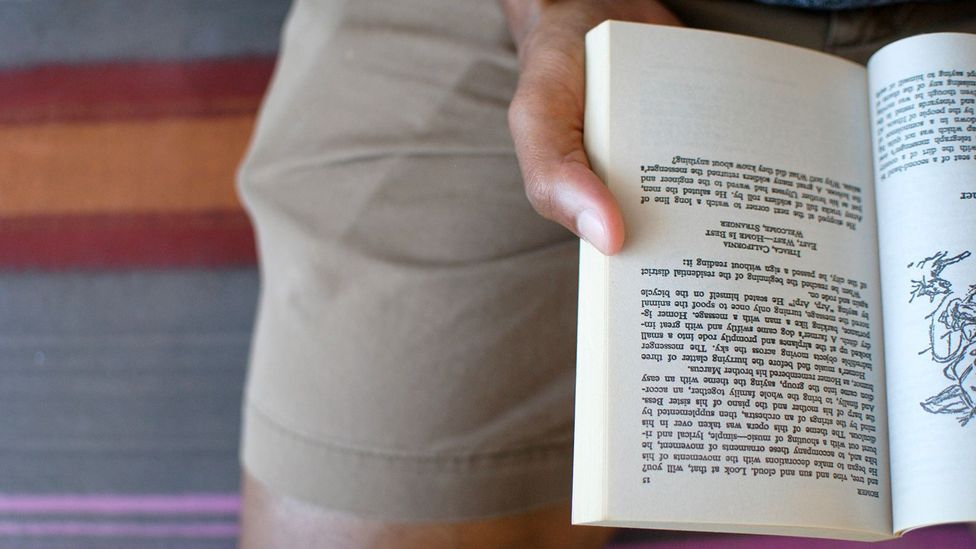
Humanities courses include subjects like English literature, modern languages, history, and philosophy (Credit: BBC/Getty)
Exercise what you dearest
This is a big function of why there is one major takeaway, says Mangan. Whatever a student pursues in academy, information technology must be something that they aren't just good at, but they really savor.
"In most areas that I tin can see, the employer simply wants to know that you've been to higher and you've done well. That's why I recollect doing something that really interests yous is essential – considering that's when you're going to do well," she says.
No thing what, making a degree or career path decision based on boilerplate salaries isn't a good move. "Financial success is non a skillful reason. It tends to be a very poor reason," Mangan says. "Be successful at something and money will follow, as opposed to the other mode around. Focus on doing the stuff that you honey that you'll exist so enthusiastic almost, people will want to requite you a job. And then go and develop within that job."
This speaks to a broader indicate: the whole question of whether a educatee should choose Stem versus the humanities, or a vocational grade versus a liberal arts degree, might be misguided to begin with. It's non equally if almost of us take an equal amount of passion and aptitude for, say, accounting and art history. Plenty of people know what they love nigh. They simply don't know if they should pursue it. And the headlines near of us come across don't assistance.
This is part of why parents and teachers often need to take a pace dorsum, Mangan says. "There is only one expert. I'thou the expert on me, you're the proficient on yous, they're the expert on themselves," she says. "And nobody, I really hateful nobody, can tell them how to practice what they should be doing."
Fifty-fifty, information technology seems, if that means pursuing a "useless" degree – like one in liberal arts.
--
Amanda Ruggeri is a senior journalist and editor at BBC.com. You tin can follow her on Twitter at @amanda_ruggeri.
To comment on this story or anything else yous accept seen on BBC Capital, please head over to our Facebook page or message us on Twitter .
If you lot liked this story, sign upwardly for the weekly bbc.com features newsletter called "If Yous Merely Read half dozen Things This Week". A handpicked selection of stories from BBC Future, Culture, Capital and Travel, delivered to your inbox every Fri.
Source: https://www.bbc.com/worklife/article/20190401-why-worthless-humanities-degrees-may-set-you-up-for-life
0 Response to "Working I Corporate Is the Only Thing I Can Do as a Liberal Arts Graduate"
Post a Comment